Publishers Own the Audience. Why Don’t They Own the Transaction?
Publishers create the demand, but the purchase, the data, and the long-term value are captured elsewhere
For example, 69% of consumers say they trust influencer recommendations when evaluating products, and 81% conduct research online before making a purchase. In theory, that should make commerce a major revenue stream for publishers — especially as the affiliate marketing industry is projected to reach $17 billion this year.
In practice, the opportunity remains under-realized. Only 28% of publishers cite e-commerce as a core revenue stream yet 37% acknowledge that developing new products and services is needed to achieve growth in 2026.
The gap isn’t explained by lack of influence.
It’s structural.
The dominant model — affiliate links — monetizes the click, not the transaction.
That raises a more fundamental question: If publishers own the audience, why don’t they own the transaction?
Challenges with the traditional commerce value chain
The traditional commerce value chain is designed to separate influence from transaction.
Content drives discovery, discovery shapes consideration, and consideration builds intent. But the transaction — where value is actually captured — happens elsewhere, inside the retailer’s environment.
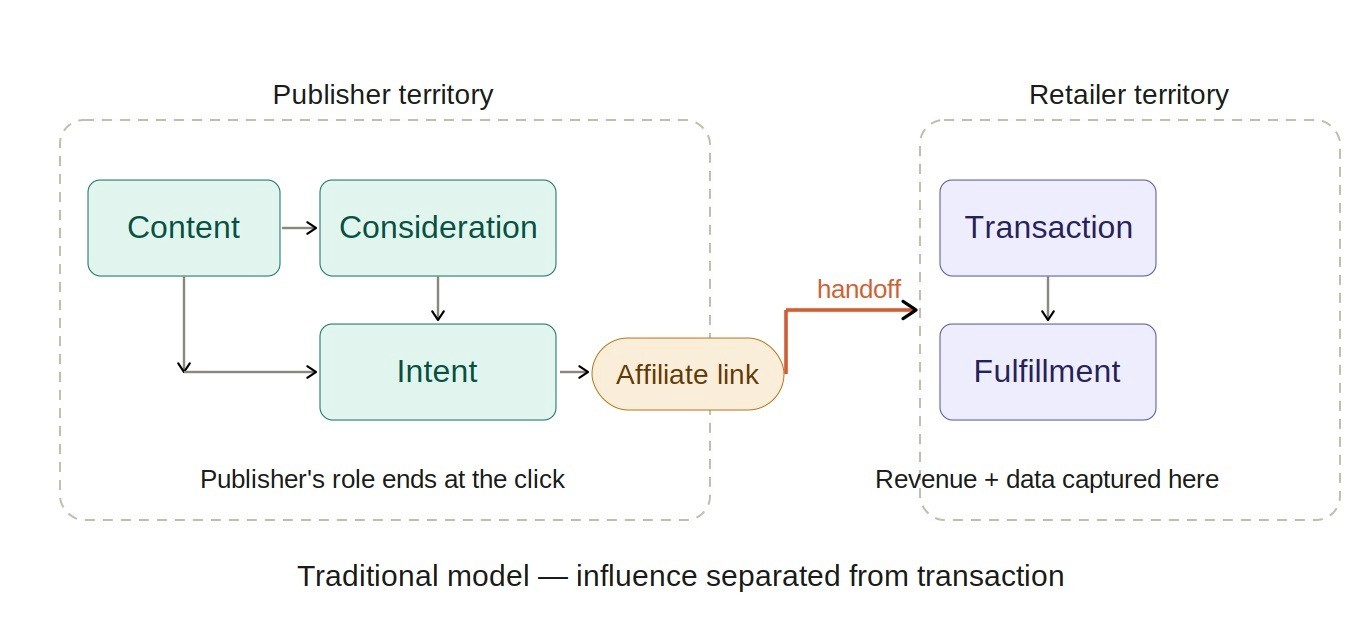
Publishers operate across the most difficult — and, arguably, most valuable — part of this chain. They create the content that moves consumers from passive browsing to active intent.
And then they exit.
At the moment a user is ready to buy, the experience breaks. The transaction shifts to the retailer, along with the revenue, attribution, customer data, and long-term relationship. Affiliate links were built to route users out of the publisher environment and into a retailer’s checkout flow. The publisher’s role ends at the click.
The result is a structural imbalance. Publishers create the demand, but don’t participate in the transaction where value is realized.
Conversion happens outside of publisher control
In the affiliate model, the final purchase takes place on the retailer’s site. Once a user clicks out, the publisher’s role effectively ends. From that point forward, conversion is determined by factors the publisher does not control: retailer UX, pricing, promotions, and checkout friction.
This creates a fundamental disconnect. Publishers do the work to generate intent, but have no ability to influence whether that intent converts — or how efficiently it does.
Attribution is fragile and incomplete
Even when a transaction does occur, publishers don’t have a reliable way to measure their impact. Affiliate attribution is inherently fragile, typically converting at just 1 – 5% due to drop-off and tracking limitations.
Credit is frequently lost due to short cookie windows, cross-device behavior, and last-click attribution models that override earlier influence. The result is an incomplete picture of performance. Publishers can’t reliably connect the content they create to the revenue it drives.
No visibility into what actually gets purchased
Because the transaction happens outside the publisher’s environment, visibility into the outcome is limited. In many cases, publishers don’t know what was ultimately purchased, the order value, whether items were returned, or how the customer behaved post-purchase.
This breaks the feedback loop required to improve performance. Without clear insight into what converts and why, it’s difficult to optimize content, refine recommendations, or scale what works.
Monetization limited to individual products
Affiliate commerce is typically built around single-product links. That makes it difficult for publishers to bundle complementary items, curate purchases across multiple merchants, or increase basket size in a meaningful way.
In other words, publishers may influence a broader purchase decision, but the monetization model captures only a narrow slice of it.
No compounding value
Affiliate revenue is generally one-time and transaction-specific. Publishers do not own the customer relationship, purchase history, or repeat behavior that would allow value to build over time.
Each transaction starts from zero. There is no durable data loop, no downstream customer value, and no mechanism for commerce revenue to compound the way subscriptions or first-party audience relationships can.
Affiliate revenue does not scale with influence
Even when affiliate programs perform as expected, revenue growth is inherently constrained. It depends on two variables publishers do not control: traffic volume and conversion on external retailer sites.
Traffic is increasingly volatile, shaped by platform algorithms, search changes, and distribution dynamics outside the publisher’s control. At the same time, conversion happens in a retailer’s environment, where factors like pricing, promotions, UX, and checkout friction ultimately determine whether a purchase is completed.
This creates a structural ceiling. Publishers can grow influence, produce more content, and drive more intent — but revenue scales only if both traffic and retailer-side conversion cooperate.
In other words, publishers are optimizing for demand, but monetization is dictated elsewhere.
For most of the internet's commercial history, this wasn't a choice publishers made — it was a constraint they inherited. Checkout infrastructure lived inside retailer environments. Payment rails, order management, and fulfillment systems weren't something a content business could reasonably operate. Sending users elsewhere wasn't a strategic concession. It was the only option.
That constraint no longer exists.
The emergence of agentic commerce infrastructure means publishers can now embed transaction capabilities directly within their environments — without becoming retailers, managing inventory, or rebuilding what already works. The retailer remains the merchant of record. Fulfillment operates exactly as it does today. What changes is where the transaction happens — and who captures the value when it does.
That's the shift. And it's available now.
Stop routing the transaction. Start owning it.
The traditional model places publishers upstream of the purchase, responsible for generating demand but removed from the moment where value is captured. Fixing that doesn’t require optimizing affiliate links. It requires rethinking the model itself.
The shift is straightforward: from referring transactions to executing them.
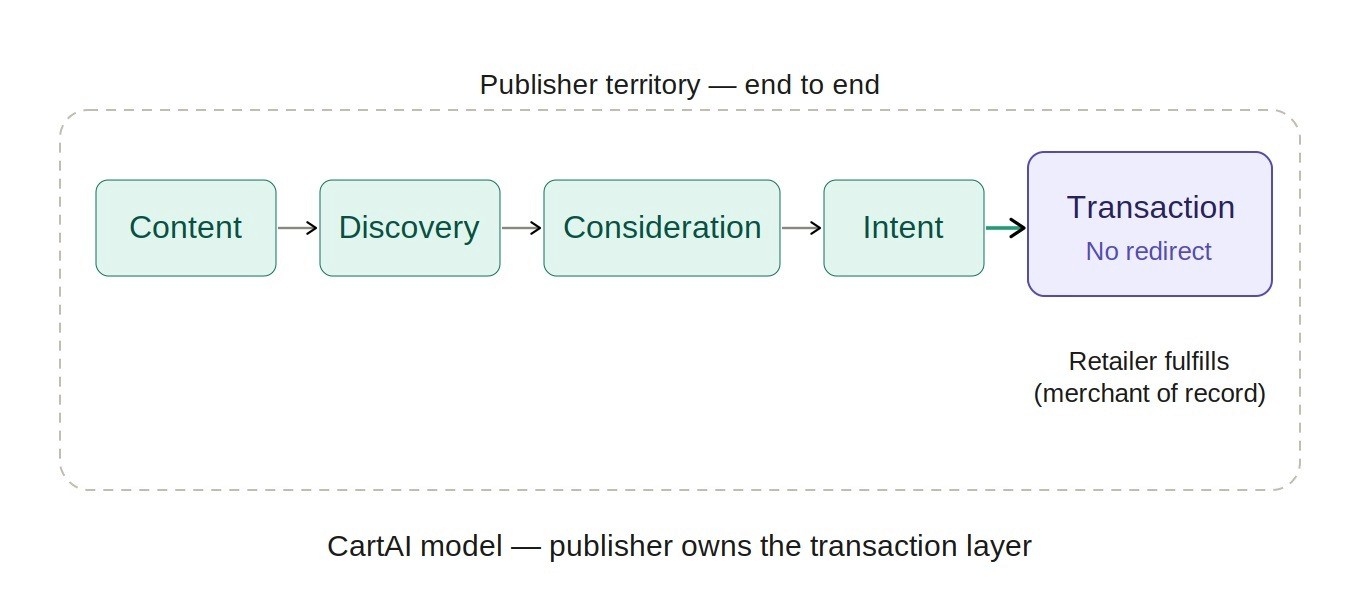
Instead of handing users off at the moment of intent, publishers can keep the transaction within their own environment — collapsing the gap between discovery and purchase. That matters because the handoff is where friction is introduced and conversion is lost. The closer the purchase happens to the moment of intent, the more efficiently demand turns into revenue.
Owning the transaction also changes what publishers can control. Revenue is no longer dictated solely by traffic volume and retailer-side conversion. Publishers gain the ability to influence how purchases happen — from how products are presented and bundled to how seamlessly the transaction is completed. The result is not just higher conversion, but more leverage over the economics of each interaction.
Just as importantly, transaction ownership restores visibility. Instead of losing insight at the click-out, publishers can see what was actually purchased, at what value, and in what context. That reconnects content to outcomes, creating a feedback loop that allows commerce to be optimized in the same way other revenue streams are.
Over time, this changes the nature of commerce entirely. Instead of one-time affiliate events, purchases become part of a system that compounds. Content is no longer just a driver of intent — it becomes a persistent transaction layer that can generate value long after it’s published.
The result is a model where publishers no longer sit adjacent to commerce. They sit inside it.
How publishers can own the transaction
Repositioning publishers inside the transaction isn’t theoretical. It’s now possible through agentic commerce.
Through platforms like CartAI’s Agentic Commerce as a Service, publishers can embed transaction capabilities directly within their content — for example, a “Buy For Me” button alongside a product recommendation. A reader discovers a product, decides to purchase, and completes the transaction without ever leaving the publisher’s site.
Behind the scenes, the retailer remains the merchant of record. Fulfillment, returns, and customer service continue to operate as they do today. The difference is not operational. It’s structural.
Instead of earning a commission on a redirected click, the publisher captures value at the moment of a completed transaction. The publisher becomes a transaction surface, not just a referral source.
That distinction matters. It reconnects influence with transaction — eliminating the forced handoff that has historically introduced friction, broken attribution, and limited revenue potential.
More importantly, it changes how commerce scales. In the affiliate model, revenue growth is tied to traffic and external conversion. In the agentic model, revenue is tied to engagement and intent. Publishers move from sitting upstream of the purchase to participating directly in it.
The result is a system where intent, transaction, and monetization happen in the same place — and where the value publishers create can finally be captured.
The new model benefits publishers
Owning the transaction doesn’t just improve monetization. It changes how commerce works for publishers.
Conversion happens within the publisher experience
Instead of handing users off at the moment of intent, the purchase happens in the same environment where the decision is made. This preserves momentum, reduces friction, and allows publishers to participate directly in conversion.
Attribution becomes clear and reliable
Because the transaction happens within the publisher’s environment, attribution no longer depends on fragile tracking mechanisms. Publishers can directly connect content to revenue, with a clear view of what drove the purchase.
Full visibility into purchase behavior
Transaction ownership restores insight into what was actually purchased, at what value, and in what context. This re-establishes the feedback loop needed to optimize content, refine recommendations, and scale what works.
Monetization expands beyond individual products
Instead of being limited to single-product links, publishers can support bundled purchases, curated recommendations, and multi-item transactions — increasing average order value and aligning monetization with how people actually shop.
Commerce revenue compounds over time
With visibility into transactions and behavior, commerce becomes a system that improves and scales. Publishers can move beyond one-time commissions toward a model where revenue builds on engagement and repeat interaction.
Own the transaction. Boost revenue.
Publisher commerce isn’t a new idea. What’s changing is where it happens.
For decades, publishers have influenced what people buy but operated outside the transaction itself. That model made sense when the only way to monetize commerce was to send users elsewhere. But as the infrastructure evolves, that separation is no longer necessary.
The next phase of publisher commerce will be defined by ownership — not of inventory or fulfillment, but of the transaction layer itself. Publishers will no longer act as intermediaries passing demand downstream. They will become environments where discovery, decision, and purchase happen together.
That shift has implications beyond revenue. It restores the connection between content and outcome, aligns monetization with user intent, and creates a model where value compounds rather than resets with every click.
The publishers that move first won't just earn more from commerce. They will define a whole new revenue source for the industry.
If you're running commerce at a publisher or affiliate network and this tension feels familiar, I'm always open to a conversation. Find me on LinkedIn or at CartAI.
Manil Uppal
Founder, CartAI