The AI Threat and How Agentic Commerce Can Help
The traditional publishing model is under threat once again. After surviving the technological transitions of radio, TV, and the internet, we now have a new disruption on the horizon: AI.
This new threat is unlike all the previous ones. AI enables users to consume content, get answers, and read summaries without navigating to the original publisher, causing only 1 in 3 media leaders to say they’re confident about journalism in 2026. That’s a reflection of shrinking referral traffic, unstable advertising revenue, and growing dependence on platforms that prioritize retention within their own ecosystems rather than external distribution.
The era in which scale alone guaranteed monetization is over. Traffic no longer compounds predictably, and advertising no longer scales in lockstep with impressions. And the 62% of media leaders who acknowledge underinvestment in future models face a clear choice: redesign their revenue strategy now, or preside over a slow erosion of leverage as platforms consolidate both attention and margin.
Publishing itself won’t go extinct. Demand for content, analysis, and connection remains durable. But the economic architecture that once supported digital media must evolve.
Publishers have always survived by expanding beyond their original mandate. Today, The New York Times offers games — bolstered by its savvy acquisition of Wordle — alongside Cooking, Wirecutter product reviews, and sports coverage through The Athletic. These aren’t side ventures or brand extensions. They reflect a deliberate redefinition of what a modern publisher is: not just a news outlet, but a diversified platform built around multiple, monetizable audience habits.
In this latest threat, too, the opportunity lies in diversification — in building revenue models that reflect how audiences actually consume content today. Publishers can’t maximize for pageviews anymore. They must maximize for revenue per visitor instead.
The publishers that survive this transition will be the ones that redesign monetization around relationships, transaction intelligence, and direct value capture — not around algorithms they do not control.
Why the imminent threat? Collapsed traffic and declining revenues.
Digital publishing built itself on borrowed land. Search and social media delivered limitless audiences at minimal marginal cost. As traffic expanded, impressions scaled with it, and advertising revenue compounded in predictable fashion.
The model rewarded volume. But now, the volume has vanished.
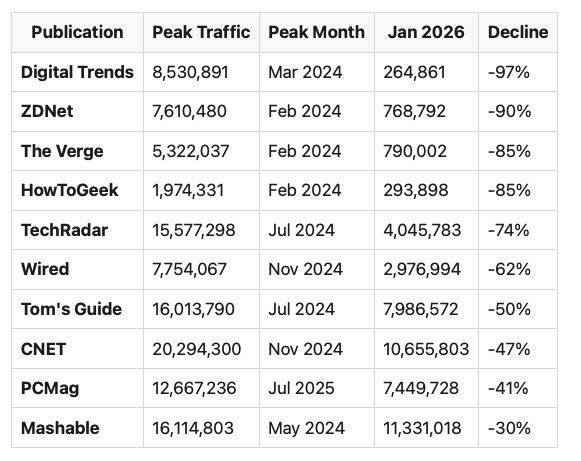
Organic traffic from Google fell 33% globally in a single year. After the launch of AI Overviews, 37 of the Top 50 U.S. news websites recorded year-over-year traffic declines. Major brands, including Forbes and HuffPost, lost roughly 40% of their traffic.
Organic traffic to tech publications for example is seeing significant declines since the rollout of Google AI Overviews
Publishers are locked into scale-dependent economics just as scale is evaporating. This reality hits revenue directly, because advertising still anchors the publisher’s business model. In 2024, 72% of media leaders said display advertising remained a very important revenue stream, albeit down from 81% in 2020.
“We’re seeing turbulence amongst our client base over unstable advertising revenues and concern about referral traffic from social media.”
— Phil Chetwynd, Global News Director, Agence France-Presse (AFP), told Reuters Institute
The fallout is already visible. Travel publisher The Planet D lost 50% of its traffic after AI Overviews launched. Traffic then fell another 90%, causing the site to ultimately shut down. Home improvement blog Charleston Crafted lost roughly 70% of its traffic in just two months, triggering an approximately 65% drop in ad revenue. Music publication Stereogum saw its advertising income slashed by 70% in 2025 amid AI-driven search changes. These outcomes are not isolated misfortune; they’re case studies in platform dependence.
And the industry is bracing for further deterioration. Publishers forecast an additional 43% decline in search traffic by 2029.
The truth is: The math at the core of traditional publishing no longer adds up.
The fragility of the click
Search engines, AI chatbots, and social platforms are now optimized for retention, not referral. Their business models reward time-on-platform over outbound clicks. Every product decision — from AI summaries to infinite scroll — is designed to reduce friction and keep users inside their environments.
The consequence is predictable: discoverability contracts, feeds replace browsers, and publishers lose the traffic that once sustained their ad revenue.
Force #1: Discoverability dwindles in a zero-click environment
Traffic is not evaporating because audiences disappeared. It is evaporating because discovery no longer routes users to publishers.
When platforms answer questions directly within search results, they are not simply reducing clicks. They are intercepting demand and retaining the value that publishers once captured.
For example, nearly 60% of Google searches now end without a click. For news-related queries, zero-click rates have climbed to nearly 69%.
Publisher referral traffic from major social networks has also declined substantially as platforms prioritize native engagement over external links. Facebook referral traffic to news sites has fallen by roughly 50% over the last year as algorithms deprioritize external links.
The click — once the currency of the open web — is being systematically removed. And, fewer clicks means fewer ad dollars.
Force #2: Editorial consumption moves away from browsers
Reduced discoverability is only part of the challenge; evolving audience behavior is compounding the revenue risk. Editorial and news consumption is no longer anchored in the browser. It is migrating decisively to environments where publishers are not the default.
Users now spend the overwhelming majority of their mobile time inside apps, not on publisher websites. More than 90% of smartphone time is spent in apps, with less than 6% in mobile browsers.
The displacement is visible in news behavior. In the U.S., 54% of people now access news via social media and video networks, surpassing both TV news (50%) and news websites or apps (48%) for the first time.
Publishers are no longer competing within a category. They are competing inside algorithmic feeds designed to keep users scrolling — not clicking.
The opportunity: Diversify the model. Monetize the relationship.
Reach may build awareness, but depth builds revenue.
By a net 38-point margin, news executives say publishers should reduce emphasis on general news coverage in 2026, an acknowledgement that scale alone is no longer a defensible growth strategy.
It is no coincidence that the bright spot in the Reuters Institute’s 2026 predictions is subscription-based publishers. Leaders in Northern Europe and North America with strong subscription models report they are doing “better than ever, financially and in audience terms.”
The audience is there. Roughly 20–25% of respondents describe themselves as “extremely” or “very” interested in news. That cohort consumes news multiple times per day and is significantly more likely to pay. Similarly, 17% of Americans currently pay for digital news, confirming that revenue is concentrated among the most engaged readers — the ones who return frequently, trust the brand, and convert.
And publishers are responding accordingly. When asked which revenue streams will matter most in the coming year, 76% of media leaders cited subscriptions, 54% pointed to events, and 28% identified e-commerce as strategically important. These models are not diversification for diversification’s sake. They are insulation. They reduce the portion of revenue that disappears the moment a platform changes its algorithm.
The future will be won by extracting more value from the audience that remains. And that shift creates space for a revenue stream built precisely for engaged readers: commerce.
Reclaiming revenue through commerce
Diversification is no longer optional, and commerce is a strategic revenue stream publishers have yet to fully activate. The global affiliate marketing industry, for example, is projected to exceed $15 billion in 2025. And, publishers sit directly upstream of buying intent, positioning them closer to transaction than most advertising models ever could. In fact, 81% of shoppers conduct online research before making a purchase.
But the dominant commerce model publishers rely on — affiliate links — was built for a different era. Affiliate marketing started simple and elegant, dating back to when William J. Tobin’s PC Flowers & Gifts paid commissions through the Prodigy Network in the early 1990s.
For publishers, it felt like found money. Write the review you were already going to write, add a link, and collect 5 – 10% when someone converts.
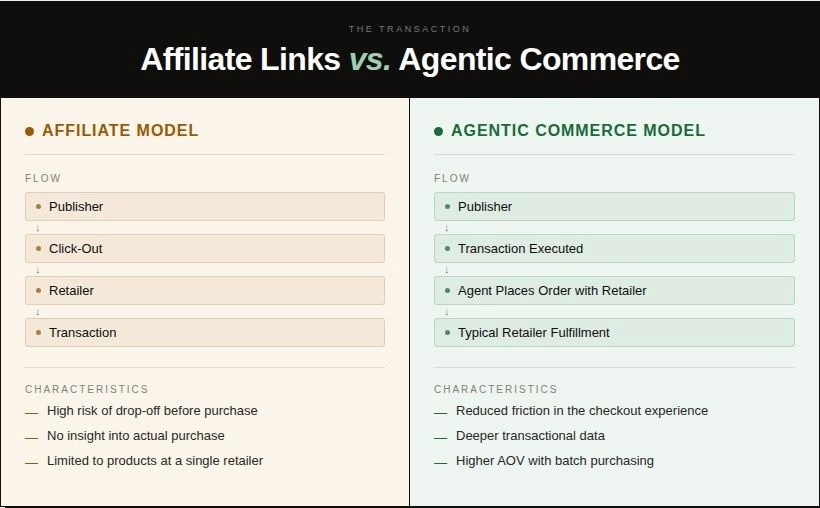
But the model carries a structural flaw: publishers capture value at the moment of the click-out — not at the moment of the transaction.
Everything downstream belongs to the retailer. Publishers became lead generators inside someone else’s ecosystem. That structural weakness manifests in predictable ways.
Attribution has grown increasingly fragile as cookie windows shrink, browsers restrict third-party tracking, and consumers move across devices. Commission rates have steadily compressed as the market flooded with product roundups and AI-generated reviews, diluting conversion efficiency. Drop-off is inevitable: Every redirect moves a reader from a trusted editorial experience into a transactional interface designed for conversion, not context.
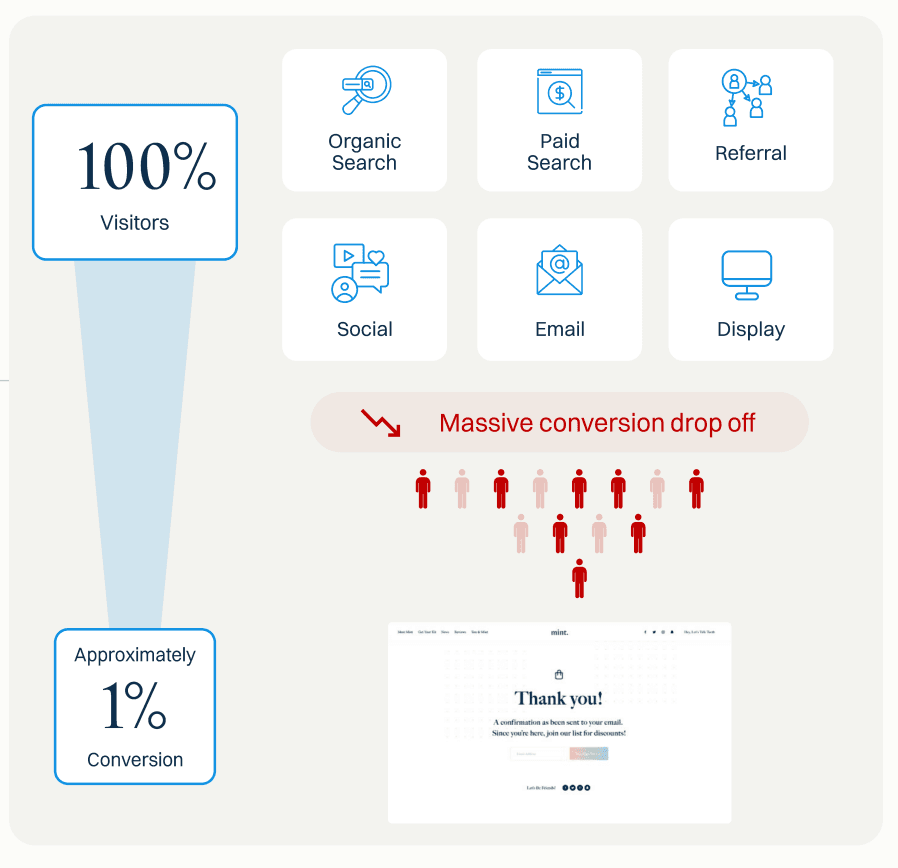
Publishers rarely know what was ultimately purchased, what the customer paid, whether the item was returned, or what that customer is worth over time. There is no meaningful data loop, no compounding advantage — only a one-time commission on a single event.
For nearly three decades, this was acceptable because there was no viable alternative. If a publisher wanted to monetize recommendations, the only option was to send the reader elsewhere.
That constraint no longer exists.
As AI agents normalize intermediary purchasing across the web, the transaction layer itself is being redefined. Consumers are increasingly comfortable allowing trusted interfaces to execute purchases on their behalf. Publishers, already positioned at the moment of intent, are uniquely equipped to become that trusted transaction surface.
Agentic commerce: How publishers avoid extinction
For decades, publishers have monetized commerce by sending readers somewhere else. Agentic commerce reverses that flow by leveraging AI to execute purchases on behalf of the reader while preserving merchant-native fulfillment.
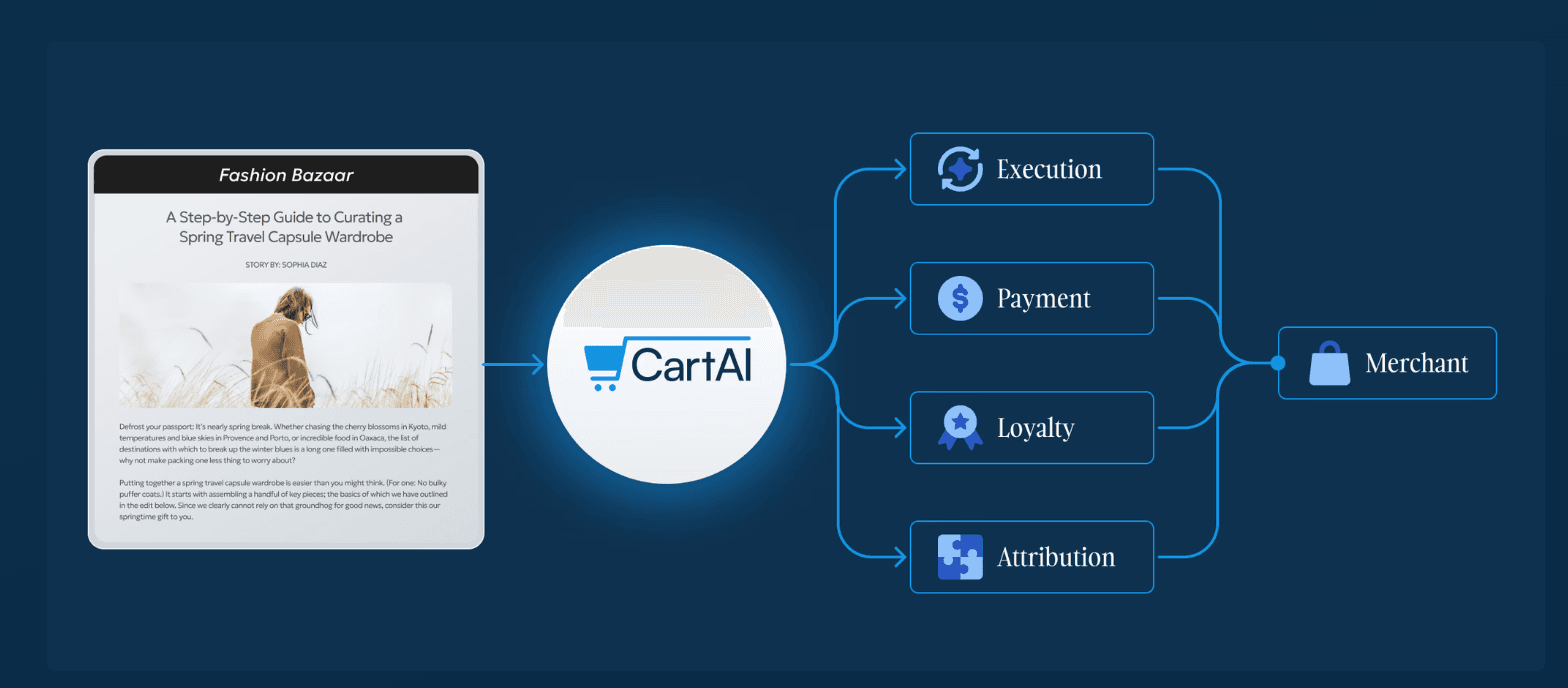
Through platforms like CartAI’s Agentic Commerce as a Service, publishers can embed a “Buy For Me” button directly within product mentions. A reader discovers a product inside an article, clicks to purchase, and completes the transaction without ever leaving the publisher’s site.
The retailer remains the merchant of record. Fulfillment, returns, and customer service remain intact. Attribution is preserved.
But the monetization leverage changes completely. Instead of earning a commission on a redirected click, the publisher captures value at the moment of a completed transaction. The publisher becomes a transaction surface — not just a referral source.
That distinction is not cosmetic. It is structural.
Most importantly, agentic commerce decouples revenue growth from traffic growth. In the affiliate model, the publisher sits upstream of the purchase. In the agentic model, the publisher sits inside the purchase flow. That shift restores control over attribution, reduces friction, and increases the revenue potential of each engaged reader.
Why agentic commerce changes the economics for publishers
Agentic commerce restructures where publishers sit in the value chain. Under the affiliate model, publishers monetize the click. Under the agentic model, they monetize the transaction. That distinction unlocks the following structural advantages.
Preserve attribution and reduce leakage
When the transaction happens inside the publisher’s environment, attribution remains intact. There is no loss of credit due to cookie expiration, cross-device behavior, or mid-funnel retargeting.
Publishers retain clear visibility into which content drives revenue and which audiences convert — restoring a feedback loop that affiliate models fragment.
Increase average order value (AOV) through curation
Commerce inside the publisher environment enables bundling and curation.
Instead of sending a reader to purchase a single product, publishers can facilitate batch purchases across multiple merchants within a single flow. That unlocks opportunities to increase average order value while reinforcing editorial authority.
Monetize the archive, not just the moment
Publishers already have thousands of evergreen articles, buying guides, and product reviews that attract high-intent audiences. Agentic commerce transforms that existing content library into an active transaction layer. Revenue no longer depends solely on new content production or traffic spikes; it activates demand already embedded in the archive.
Reduce operational burden
Because the retailer remains the merchant of record, publishers assume no inventory risk, no fulfillment obligations, and no customer service overhead. There are no complex integrations to maintain, unless desired. Agentic commerce handles transaction execution while allowing publishers to focus on content, curation, and audience relationships.
Strengthen first-party economics
Finally, agentic commerce aligns with the broader industry shift toward first-party data and direct monetization. Instead of acting as a lead-generation channel for retailers, publishers become the environment where commerce is executed. That increases strategic leverage, deepens audience insight, and supports diversified revenue beyond advertising alone.
Content performance can be optimized around actual conversion intelligence rather than outbound click volume. Over time, that compounds into stronger margins and greater strategic leverage.
Own the transaction or collapse with your traffic
Traditional publishing is not under threat because audiences disappeared. It is under threat because the economics no longer work.
The publishers that endure will be those that diversify their revenue streams and double down on deep audience experiences that create measurable value — for readers and for the business.
Commerce meets that mandate. Done right, it enhances editorial utility while unlocking durable revenue.
And agentic commerce goes further. It breaks free from the structural limits of affiliate models and unlocks real leverage: preserved attribution, higher average order value, transaction visibility, and revenue that no longer depends solely on pageview growth.
If you're rethinking your monetization strategy or exploring what agentic commerce could look like inside your organization, get in touch with us here.
Let’s build what comes next.
Manil Uppal
Founder