As we dive deeper into the world of Agentic Commerce with @CartAI, we thought we would outline the typical stack that is emerging as we talk to potential customers and partners in the ecosystem.
Roger Dunn's AI Commerce Brief article broadly divides Agentic commerce into three big buckets and it is a worthwhile read.
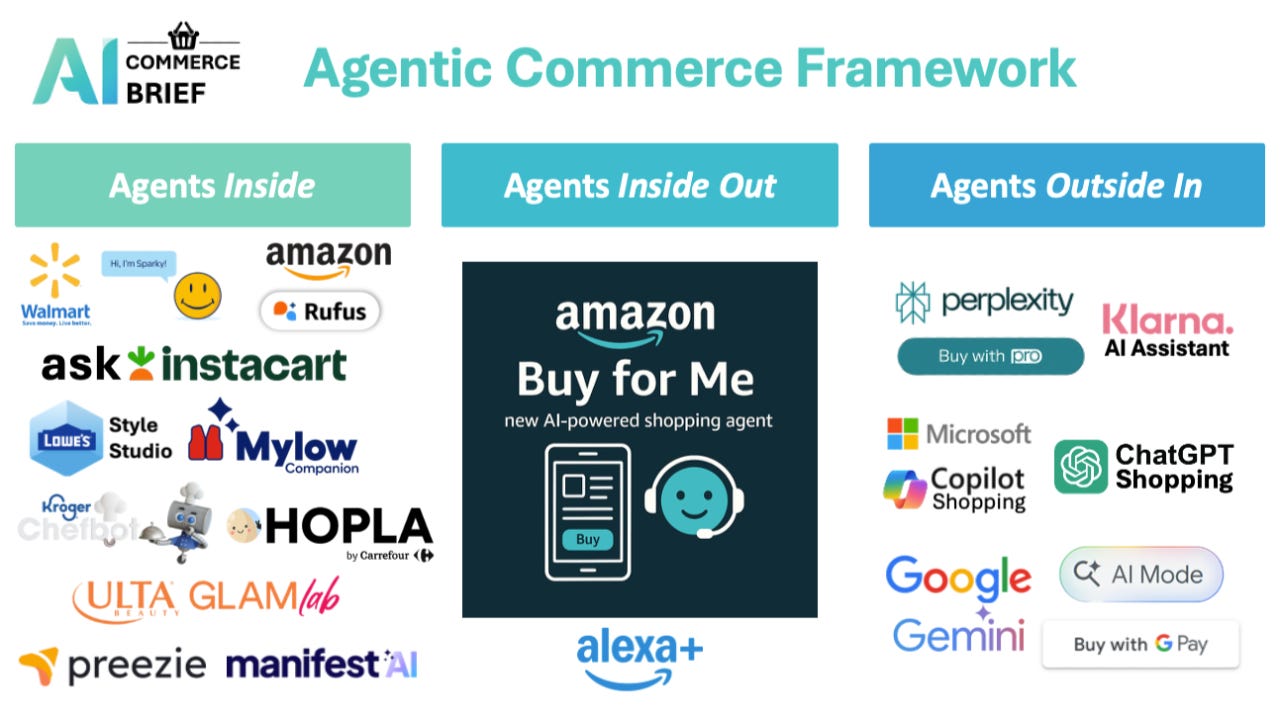
There are three layers in this shopping stack that are common across all of these buckets : Catalog, Payment and Execution
In this piece we will focus on “Agents Outside In” which we believe is the most magical manifestation of Agentic commerce. That said, you will need all three layers regardless of the framework.
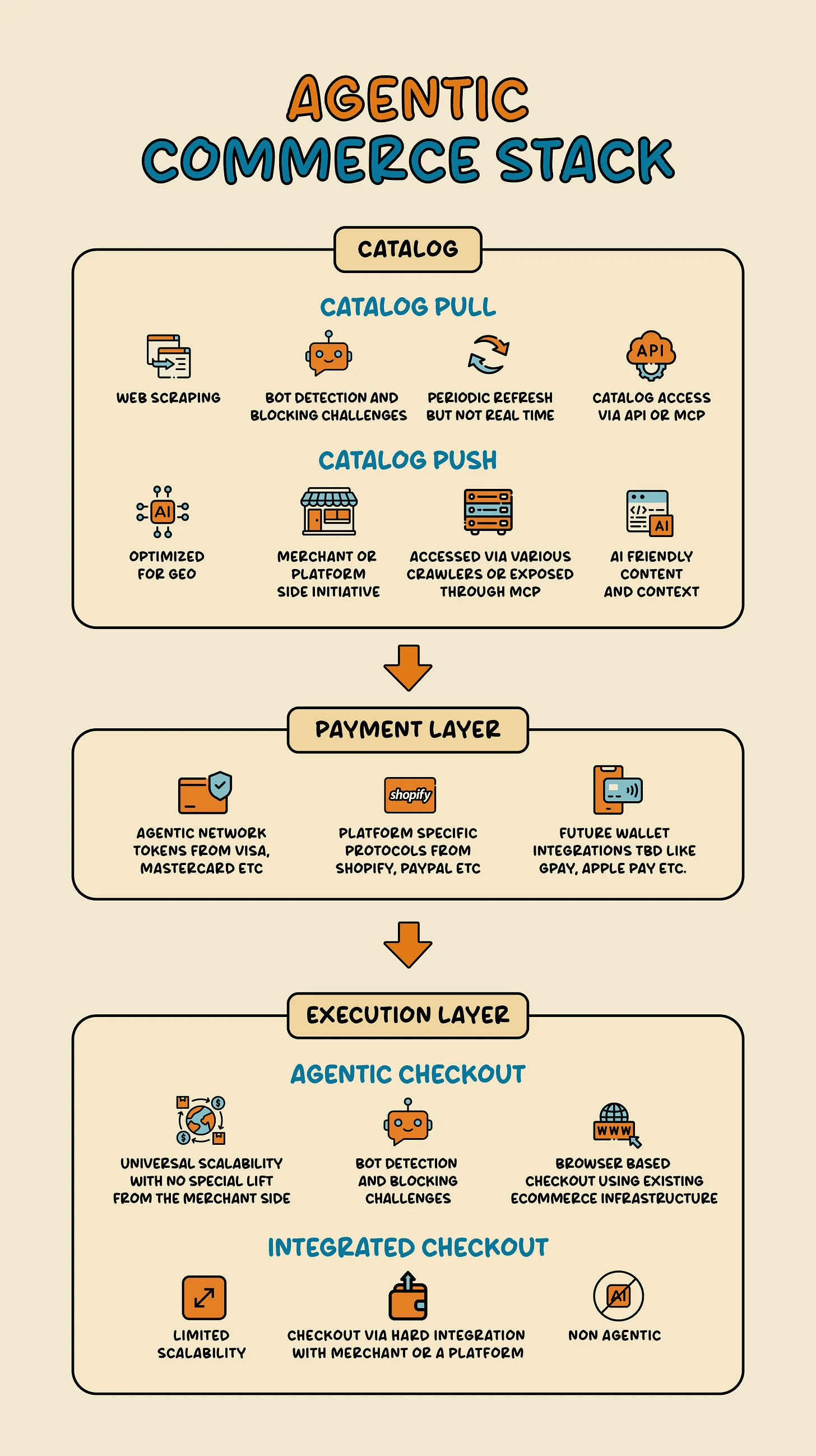
Catalog : Everything starts here. The platforms and apps that serve as the starting points of Agentic Commerce have to have a catalog from merchants and retailers. This ensures that relevant products are shown to the consumers based on both consumer input and whatever AI capabilities that app is providing.
In Chatgpt and Perplexity it could be research around a particular product. In Daydream it could be fashion advice specific to the consumer etc.
There are two typical ways of obtaining the catalog: Pull and Push
Pull: Platforms obtain catalogs using methods like web crawling or web scraping. In some cases, they may have official partnerships with certain platforms and merchants.
Push: A more emerging use case, where merchants, retailers, and e-commerce platforms proactively make their own catalogs friendlier for AI consumption. A whole science is emerging around GEO (Gen-AI Engine Optimization), which is well covered in Retailgentic’s stack here
Shopify and Paypal recently introduced agentic tools for this exposed via MCP servers. If you play in the big leagues like Google, Perplexity etc, they have merchant centers where retailers upload their catalogs.
Payments : Every checkout needs a way to collect payment and agentic payments are a bold new frontier. Checkouts are easier when companies like Google and Amazon already have your card on file. For the rest—especially for apps that facilitate the “Outside In” flavor of agentic commerce—payments needs to be handled in a PCI compliant way.
Visa and Mastercard recently came out with the agentic network token concept where they issue a token and a dynamic CVV valid for a single transaction. This makes the entire transaction much more secure and less burdensome from a PCI compliance standpoint. Shopify and Paypal have also made plays to make Agentic commerce easier. Still missing from the lineup are wallets like Gpay and Apple Pay.
These are still early days for payments in the Agentic Commerce world. Ultimately, the consumer’s ideal experience will be the ability to use any payment method—just like in today’s e-commerce checkouts, which typically accept all major credit cards, digital wallets, and even BNPL providers like Klarna.
Execution : Our favorite topic, mainly because we at CartAI play in this layer and live and breathe it every day. The execution layer is where the checkout happens and the order gets placed at the merchant platform. This can be done in one of two ways, Agentic or Integrated.
Agentic flows are browser-based agents navigating merchant websites that were originally optimized for human shoppers (and often designed to keep “bots” out). The biggest advantage of this approach is that it requires no additional investment from the merchant or retailer in terms of integration (payments, order management, etc.). It can work with today’s existing e-commerce infrastructure, theoretically enabling universal scale since your reach isn’t limited to merchant or platform specific integrations. This approach also does not require writing and maintaining merchant or platform specific integrations.
Integrated flows represent the more traditional way of placing orders. Here, there is some type of connection with the merchant or platform. This could be a payment-only integration (e.g., using Stripe, where payments are transmitted to the merchant’s account) or a deeper integration where both payment and cart are transferred directly into the merchant’s systems for further execution. This approach has its advantages, such as lower latency, and makes more sense at the ecommerce platform level, where one integration can potentially unlock access to many merchants.
At the end of the day, there is no silver bullet in the execution layer. We suspect that the winners here will be those who are most flexible in their approach, provide the most value to the initiating platform and by extension to the end consumers, and abstract away execution complexities to make the process seamless.